
Guide · Northville, MI
How to Choose Gutter Guards: A Northville Homeowner's Guide
Walk into any home store and you'll find a dozen "gutter guards," from foam inserts to steel mesh. They are not equally good. Here's how to tell which type actually fits your home.
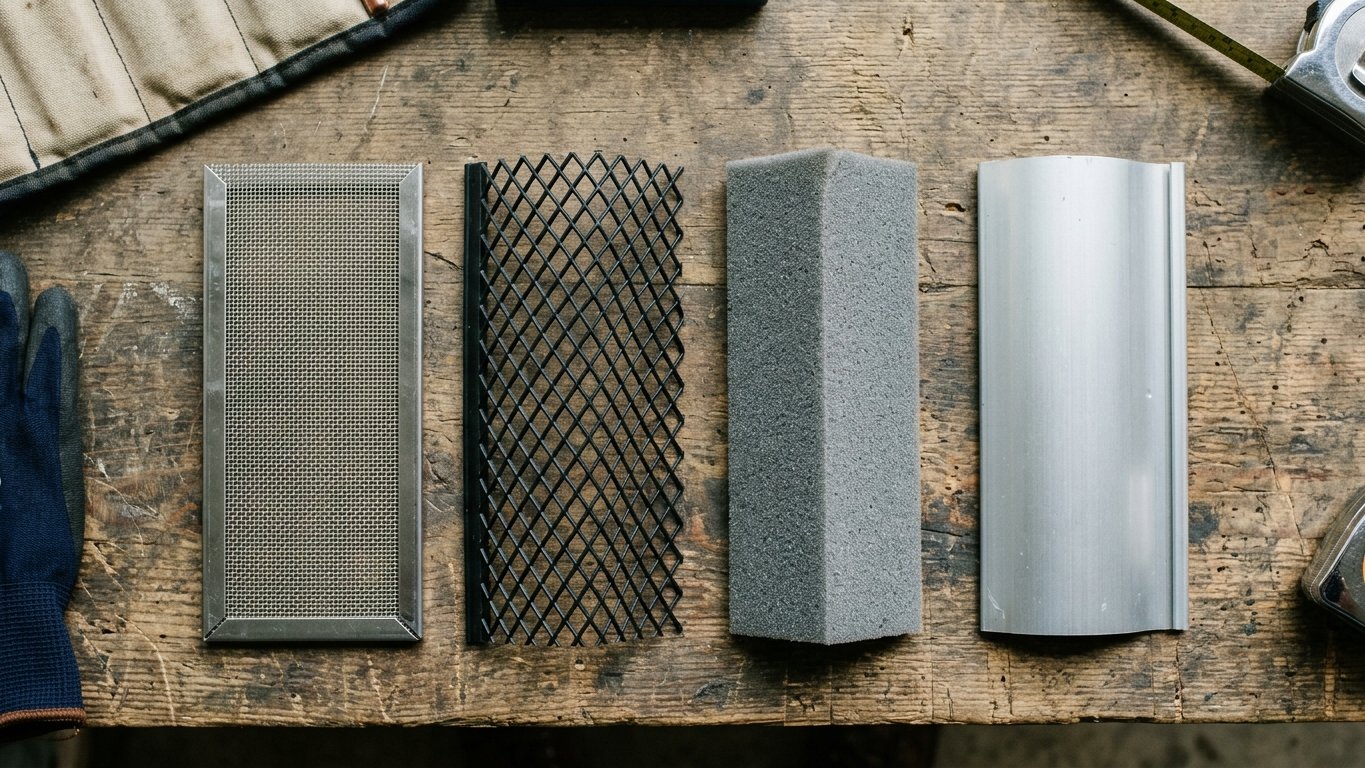
Start with what falls on your roof. If you mostly battle whole leaves, a simple screen or solid cover can work. If you also get shingle grit, maple seeds, and pine needles — the Northville reality — you need fine micro-mesh, because anything coarser lets the small stuff through.
Next, judge the build. Foam and brush inserts sit inside the gutter, collect debris, and break down in a few seasons. Plastic screens clog and turn brittle in the sun. Reverse-curve helmets let fine grit ride the curve into the gutter and can be visible from the street. Rigid stainless micro-mesh on an aluminum frame avoids all three failure modes.
Finally, weigh installation. A guard is only as good as the gutter under it and the hands that fit it. Professional installation means the gutter is cleaned, re-pitched, and re-hung first, and the guard is fastened so it won't lift in wind or trap water. A bargain guard installed over a bad gutter is money wasted.
For most homes here we recommend the micro-mesh guards we install, which filter at the surface so only water gets through.
Whatever type you choose, have them professionally installed over a sound, properly pitched gutter.
Start with what actually falls on your roof
The right guard is the one matched to your specific debris, so spend a few minutes naming what lands in your gutters before you compare products. A Northville lot shaded by mature maples and oaks sheds whole leaves in fall, but it also drops fine grit twice a year: maple seed wings, oak tassels in spring, and the broken-down skeletons of last year's leaves. Pines add needles that thread through almost any opening.
The trap is choosing for the obvious debris and forgetting the small stuff. A wide screen handles the leaves you can see, then lets seeds, shingle grit, and needle fragments wash straight in, where they pack into a mat that holds water. If your trees produce fine material on top of leaves, the only opening size that consistently keeps both out is a tight micro-mesh, and that requirement should drive the rest of your decision.
The main guard types, ranked by how they fail
Judge a guard by how it breaks down over years of Michigan weather, not by how it looks on day one. Foam inserts and brush bristles sit inside the trough and collect the very debris they are meant to block; they hold moisture, grow grime, and turn into a sponge you eventually have to dig out. Plastic and vinyl screens go brittle under UV and freeze-thaw, then crack or sag, and their larger holes still admit seeds and needles.
Reverse-curve or surface-tension covers route water around a nose into a slot, which sheds whole leaves well, but grit and shingle granules can ride the same curve right into the gutter, and in heavy downpours water can overshoot the lip entirely. A rigid micro-mesh panel mounted on a stable aluminum frame avoids most of these failure modes at once: the fine mesh stops small debris, the rigid surface will not sag, and metal does not get brittle in the cold. Knowing how each type fails tells you more than any feature list.
Questions to ask any gutter guard installer
Ask what happens to the gutter itself before the guard goes on, because that step matters as much as the cover. A good installer will clean the trough, check the pitch toward the downspouts, and re-secure or re-hang sagging sections so water actually reaches the outlets. If those steps are skipped, you are simply capping an old problem.
Then ask about the mesh opening size and frame material, how the guard attaches at the roof edge, and what the maintenance expectation is over time. Be specific: ask whether the attachment method lifts shingles or slides under them, and what they recommend for the pine needles or fine seed your particular trees drop. Clear, plain answers are a good sign; vague reassurance is not.
Why installation quality decides whether guards work
Even the best guard fails if the gutter underneath it cannot move water, so installation quality often matters more than the product brand. A gutter that pitches the wrong way, sits loose on tired hangers, or stays partly clogged will pond and overflow no matter what sits on top. Guards are not a fix for a tired gutter system; they are the final layer on a system that already drains properly.
Fit at the roof edge is the other half. The guard has to sit so water sheets off the shingles and onto the mesh, not behind the gutter or over the front lip. Slope, overhang, and the height of the first course of shingles all change that geometry, which is why a careful measure-and-adjust install beats a one-size approach pressed onto every house on the street.
What gutter guards typically cost, and what drives the number
Guard pricing is driven by a few things rather than a single sticker number: the total footage of gutter, the height and reach of your roofline, the guard material and quality, and the condition of the gutters underneath. A simple single-story run with sound gutters sits at the low end, while a tall, complex roof that needs repairs or new gutters first costs more.
It is worth pricing the guard against what you spend on cleaning, not against the cheapest cover on the shelf. A bargain product that clogs or fails in a few winters means paying again, while a quality system installed correctly is usually the better value measured over the years you own the home. Ask for an itemized estimate so you can see exactly what you are paying for.
DIY kits versus professional installation
Home-store guard kits look inexpensive, and for a short single-story run a handy homeowner can fit them. The catch is that the kit does nothing about the gutter beneath it, and most guard failures trace back to a gutter that was clogged, mis-pitched, or loosely hung before the cover ever went on.
Professional installation includes the unglamorous part that makes guards work: cleaning and flushing the run, correcting the pitch, re-securing hangers, and fitting the panels so water sheets cleanly off the roof edge. It also keeps you off a ladder. For two-story homes or steep roofs, that safety alone usually justifies having it done rather than attempting it yourself.
Frequently asked questions
Are cheap gutter guards worth it?
Foam and brush inserts are inexpensive but collect debris and degrade within a few seasons, so you often pay twice. Rigid micro-mesh costs more up front and lasts far longer, which usually makes it the better value over time.
Do gutter guards work on all roof types and pitches?
Most guards can be fitted to common asphalt-shingle roofs across a wide range of pitches, but the details change with the roof. Very steep roofs send water off fast, so the guard has to handle higher flow without overshooting; low-slope roofs and valleys concentrate debris and water, which favors a fine, rigid mesh. Metal, tile, and wood roofs need an attachment method suited to that surface, so the install should be matched to your roof rather than assumed.
Can gutter guards damage my roof or void a roofing warranty?
They can if they are attached the wrong way, which is why the mounting method matters. Some older systems wedge under the shingles and can lift or loosen them over time, and any change a roofer did not authorize may affect a roofing warranty. A careful installer attaches the guard to the gutter or fascia without disturbing the shingle course. If your roof is newer and still under warranty, ask the installer how they mount it and confirm it will not conflict.