
Guide · Northville, MI
Gutter Cleaning vs. Gutter Guards: Which Is Right for You?
If you're tired of climbing a ladder twice a year, you've probably wondered whether guards are worth it or whether you should just keep cleaning. Here's the honest comparison.
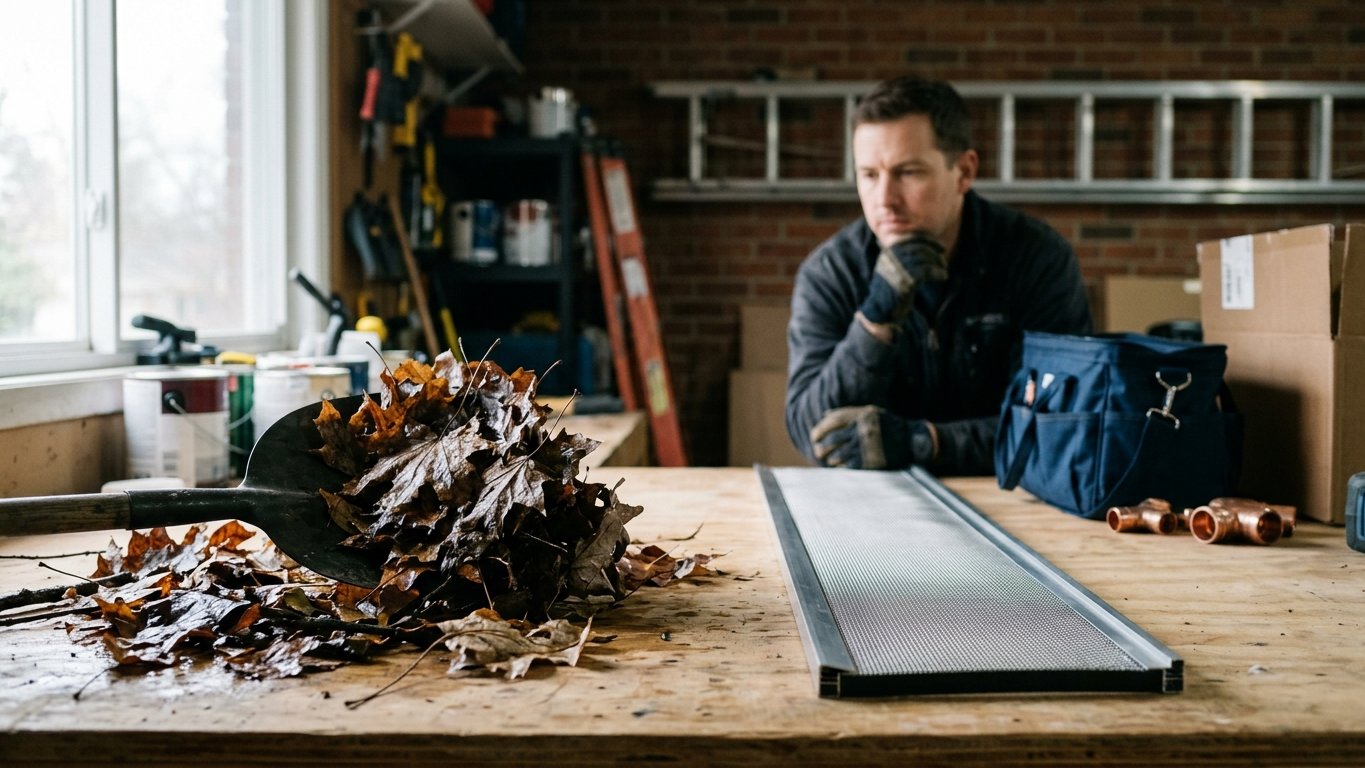
Regular cleaning is the lower up-front cost. For a home with few trees, two cleanings a year may be all you ever need, and there's no reason to spend more. The catch is that the cost never stops and the risk of a missed season — overflow, fascia rot, an ice dam — is always there.
Guards are the higher up-front cost that ends the cycle. You pay once, and the recurring cleanings (and the ladder risk that comes with them) largely go away. Under heavy tree cover, the avoided cleanings and prevented damage typically pay back the install within a handful of seasons.
The deciding factors are your tree load, how many stories you'd otherwise be climbing, and how much the chore costs you in money or stress. For most tree-shaded Northville homes, guards win the long game; for a sparse lot, scheduled cleaning is perfectly sensible.
You can keep paying for seasonal cleanings on a schedule that keeps the system clear.
Or you can install guards once and be done, which is the route most tree-shaded homes here choose.
The ladder is part of the cost too — CDC ladder-safety guidance highlights how common ladder injuries are around the home, which is the risk you retire when guards end the twice-a-year climb.
The real, recurring cost of cleaning over time
Cleaning looks cheap because you only see one bill at a time, but the true cost is every bill stacked across the years you own the house. Under the mature trees common in Northville, gutters fill at least twice a year: once after the spring seed drop and again after the fall leaf fall, sometimes a third time when pine needles keep shedding. Each visit is a separate charge that never goes away as long as the trees stand.
The cost also tends to drift upward. Two-story homes, steep pitches, and gutters clogged hard enough to need scooping rather than flushing all raise the price of a visit. When you add up a decade of those visits, the number is usually far larger than homeowners expect, because they are comparing one cleaning to one guard install instead of a lifetime of cleanings to one install.
What guards cost, and what they save
Guards cost more on the day they go in, and that single number is what makes people hesitate. What that up-front figure buys is the end of the recurring cycle: instead of paying again every season, you pay once to keep most debris out and let the gutters drain on their own. The savings are not just the cleaning fees you stop paying but the overflow damage you avoid when a season gets missed.
Guards do not erase maintenance entirely; a light rinse or an occasional check still has its place, especially under heavy pine. But the difference is between a quick top-side glance and a full ladder-and-scoop job. Under dense tree cover, the saved cleanings tend to cover the cost of the guards within a handful of seasons, after which the system mostly pays for itself.
A simple break-even way to think about it
You can decide this with arithmetic instead of a sales pitch. Estimate what you spend on cleaning in a typical year, count how many times a year your trees force the issue, and project that out over the years you plan to stay in the home. Then set that running total beside the one-time cost of having guards installed correctly.
Wherever the cleaning total passes the install cost is your break-even point, and everything after it is money kept. Homes with light tree cover may never cross that line, which is a fair reason to keep cleaning. Homes buried under maples and oaks usually cross it quickly, especially once you also count the years of avoided water damage that never show up on a cleaning invoice.
The hidden cost of ladder work and missed seasons
The part no invoice captures is the risk of the ladder itself. Cleaning a two-story gutter means standing high on an extension ladder, often on uneven ground, reaching to one side to scoop wet debris. That is genuinely dangerous work, and the value of never having to do it, or never asking a family member to, belongs in the comparison even though it has no dollar sign.
Then there is the missed season. Skip one fall because life got busy, and a packed gutter overflows against the fascia, soaks the soffit, or freezes into an ice dam at the eave over a Michigan winter. The repair from one overflow event can dwarf years of cleaning fees, which is the strongest argument for a system that does not depend on you remembering.
When sticking with cleaning is the smarter call
Guards are not automatically the right answer for every home. If your lot has few overhanging trees, your gutters may stay clear with a single annual cleaning, and the up-front cost of guards would take many years to pay back. A single-story home that is quick and safe to service also tilts the math toward simply keeping up with cleanings.
Short-term ownership changes it too. If you expect to sell within a year or two, you may not be in the home long enough to recover the install cost, though guards can still add appeal for a buyer. The honest answer depends on your trees, your roof, and your plans, not on a blanket rule that guards always win.
How the math shifts as your trees mature
Trees do not stay the same size, and neither does the debris they drop. A lot that needed one cleaning a year when the maples were young can need two or three once the canopy fills in and starts shading the roof. As that happens, the recurring cleaning cost climbs while the one-time cost of guards stays fixed.
That is why a calculation that favored cleaning a decade ago can flip toward guards today. If you have noticed your gutters filling faster than they used to, it is a sign the break-even point has moved closer, and it may be worth pricing guards even if you ruled them out before.
How guards and cleaning play at resale
If you are weighing this with a sale in mind, gutters factor into a buyer's impression more than most homeowners expect. Clean, sound gutters with guards read as a maintained home and quietly remove a worry from the buyer's list, while overflowing or sagging gutters invite questions about water damage underneath.
Guards can be a modest selling point, especially to buyers who would rather not climb ladders, though they rarely return their full cost in the sale price alone. If you are staying for years, install them for your own benefit; if you are selling soon, at minimum make sure the gutters are clean and draining so they are not a red flag during the buyer's inspection.
Frequently asked questions
Do gutter guards eliminate cleaning entirely?
Not entirely, but nearly. Guards keep debris out of the gutter, leaving at most a rare rinse of the mesh surface — a fraction of the work and risk of scooping out an open gutter twice a year.
How often would I still need to clean gutters that have guards?
Far less often, and the job is much lighter when you do. Good micro-mesh guards keep leaves, seeds, and most grit out, so instead of scooping packed debris twice a year you are mostly checking that the mesh surface is clear and rinsing off fine film. Under heavy pine, a periodic top-side brush-off helps. The shift is from a recurring full cleaning to an occasional quick inspection, which is the point of installing them.
Are gutter guards worth it on a single-story home?
They can be, and the deciding factor is trees more than height. A single-story home is safer and cheaper to clean, so if your lot has few overhanging trees, ongoing cleaning may stay reasonable. But a one-story house parked under mature maples or pines still fills its gutters every season, and guards still end that cycle. Weigh how much debris actually falls and how much you value skipping the chore, not just the number of stories.