
Northville, MI
Downspout Installation in Northville, MI
A gutter is only as good as the downspout it drains into. We add, resize, and re-route downspouts so roof water leaves the house instead of pooling against the foundation.
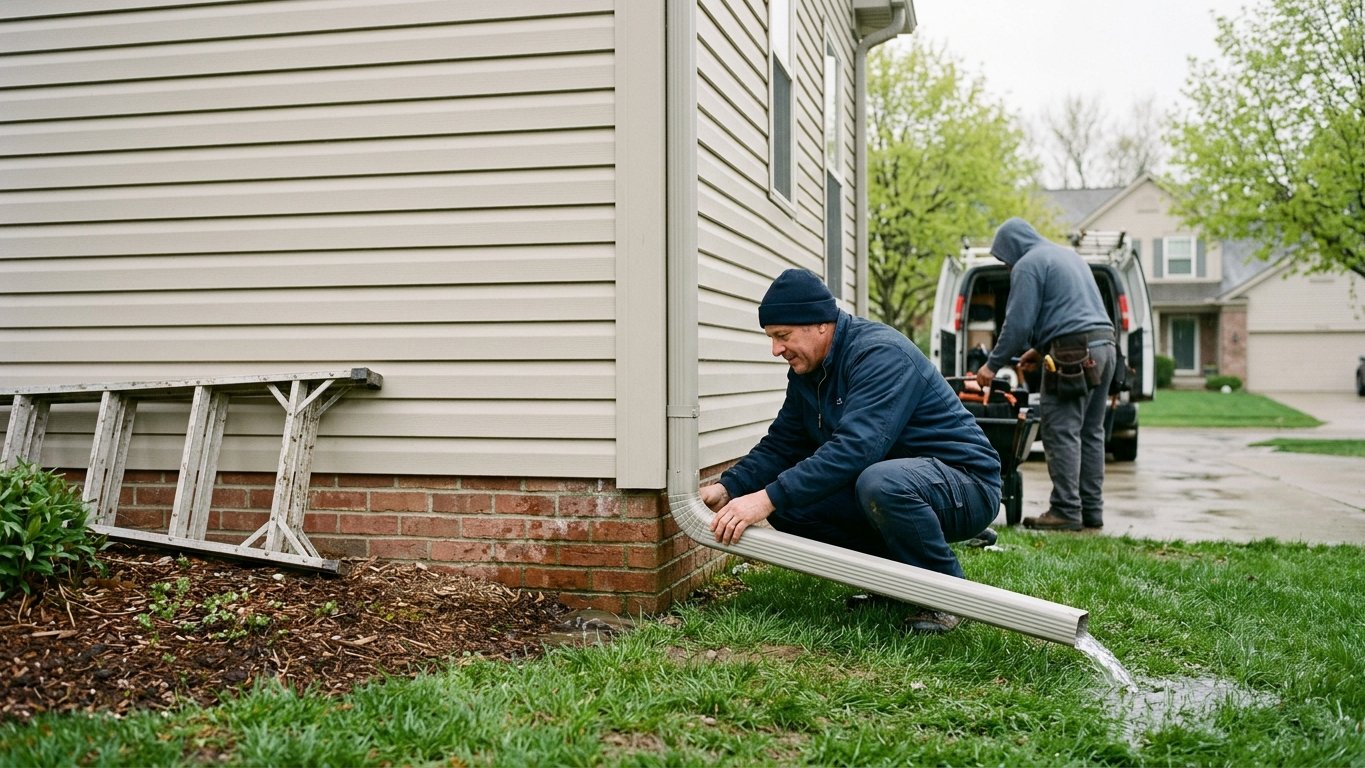
If your gutters overflow at the corners even when they're clean, you likely don't have enough downspout capacity. We add outlets and right-size the spouts so a thousand-gallon downpour has somewhere to go.
Where water dumps right at the foundation, we install extensions, splash blocks, or underground drains that carry it well clear of the house. Keeping runoff away from the basement wall is the single cheapest thing you can do to protect your foundation and grading.
We match downspout color and profile to your gutters and trim, and route them along the cleanest path down the elevation so they disappear into the architecture instead of cutting across a window.
We size and aim every outlet so water leaves the house for good — home-inspection guidance recommends discharging runoff four to six feet from the foundation, which is exactly what protects your basement and grading.
Downspouts are the drainage half of our whole-home gutter system work, carrying water from the roof edge to the discharge point.
Signs your downspouts are undersized or too few
The clearest tell is overflow at the corners during a hard rain even though the gutters are clean. When water sheets over the front edge near a downspout, the outlet simply cannot drain the run as fast as the sky fills it.
Other signs include erosion or a dug-out trench under one outlet, ice building at a single spout in winter, and long gutter runs served by only one downspout. Each points to capacity that has not kept up with the roof above it.
Carrying water safely away from the foundation
A downspout that dumps right at the wall just relocates the problem to your basement and footings. The goal is always to release water far enough out that it flows away from the house instead of soaking back toward it.
We look at grade and landscaping to pick the cleanest path, then route the discharge so it sheds downhill. On lots that slope toward the home, getting water past that low point is the whole job, and it is worth doing right.
Extensions, splash blocks, and underground drains compared
Splash blocks are the simplest option: they break the force of the water and nudge it away, but only a short distance. Hinged or roll-out extensions reach farther and can be lifted for mowing, though they need to be put back to do their job.
Underground drains carry water the farthest and keep the yard clear of hardware, which suits homes where the discharge point is well away from the house. We match the approach to your grade, your landscaping, and how far the water truly needs to travel.
Sizing outlets and spouts for Michigan downpours
Western Wayne and Oakland County summers bring cloudburst downpours that arrive all at once, and the outlet hole feeding the downspout is often the real bottleneck, not the spout itself. A larger or extra outlet lets a run drain before it backs up and spills.
We size outlets and downspouts to the roof area draining into each run, and we keep the routing clean with as few tight bends as possible. Fewer elbows means less chance for debris to catch and less drag on fast-moving water.
What's included
- Added or resized downspouts for adequate capacity
- Extensions, splash blocks, or buried drains away from the foundation
- Color-matched profile to the gutters and trim
- Clean routing down the elevation
- Flow test from gutter outlet to discharge point
Perfect for: Homes with overflowing corners, water pooling near the foundation, or too few downspouts for the roof.
Frequently asked questions
How far should a downspout discharge from the house?
Far enough that water doesn't soak the soil against the foundation — generally several feet, using an extension, splash block, or buried drain line. We set the discharge point based on your grading so water flows away, not back.
Can adding a downspout stop my gutter from overflowing?
Often, yes. Overflow at the corners frequently means the existing downspouts can't drain the volume fast enough. Adding an outlet or upsizing the spout relieves the bottleneck.
How many downspouts does a typical house need?
It depends on roof area and gutter length, not a fixed number. Each downspout can only drain so much run before it overflows, so longer runs and larger roof sections need more outlets. Corners that consistently spill in heavy rain are usually telling you a run is serving too much roof for one spout. We size the count to what is actually draining into each line.
Do downspouts freeze or clog in winter, and what helps?
They can, especially when leaves settle in the elbows before the cold and then meltwater refreezes inside. Keeping outlets and spouts clear before winter is the main defense. Generous outlet sizing, smooth routing with few tight bends, and discharge that drains fully rather than pooling all reduce the chance of an ice plug forming at the bottom of the run.
Can downspouts connect to an underground drain?
Yes, and it is a clean solution where the discharge point is well away from the house. We can tie a downspout into a buried drain line that carries water out to daylight or a suitable outlet, keeping the yard clear of hardware. The key is making sure the underground run drains fully and does not become its own clog point, so we size and route it to stay clear.
Will a new downspout match my gutters?
Yes. We match the downspout profile and color to your existing gutters and trim so an added or replaced spout blends in rather than standing out. We also route it down the cleanest path on the elevation, tucking it into corners or alongside trim where we can, so it reads as part of the house rather than an afterthought.